
The Materials pillar focuses on the development of biomimetic phantom materials that replicate the acoustic, mechanical, and optical behaviour of biological tissues under controlled stimulation conditions.
The main objective is to provide biomimetic and reproducible testing environments that enable reliable validation and calibration of stimulation technologies.
This research line addresses the fabrication of ultrasound and elastography phantoms designed to reproduce the mechanical, viscoelastic, and anisotropic properties of soft biological tissues.
Bio-elastomeric composite phantoms reinforced with natural fibers were developed to mimic the layered and directional architecture of tissues such as skin, muscle, and brain matter.
Key characteristics:
• Controlled anisotropy through fiber alignment;
• Tunable stiffness and damping properties;
• Layered, tissue-inspired configurations.
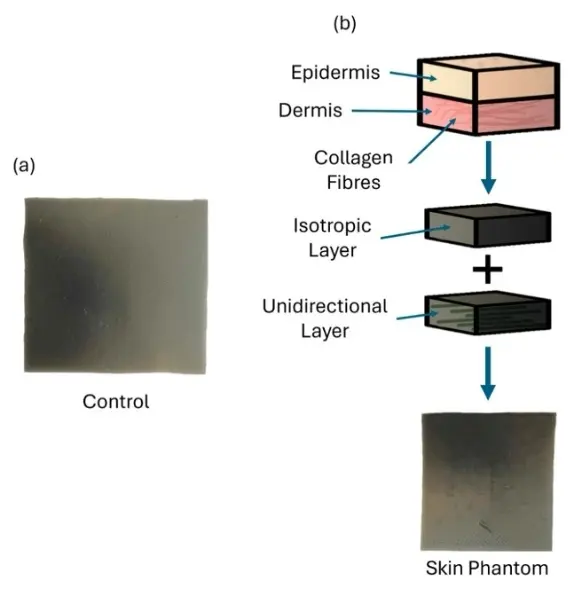
Fig. 10 — Schematic and real images of the two fabricated sample types: (a) Control sample made entirely of silicone matrix without fibers. (b) Skin phantom inspired by skin anatomy, with an isotropic silicone layer mimicking the epidermis and a unidirectional fiber-reinforced layer mimicking the dermis and its collagen fiber alignment (Langer’s lines).
To integrate sustainability into material design, waste-based fibrous phantoms were developed using cotton fiber waste and polyester nonwovens.
These phantoms offer:
• Environmentally responsible material sourcing;
• Acoustic and mechanical realism for shear wave studies;
• Scalable and cost-effective fabrication.
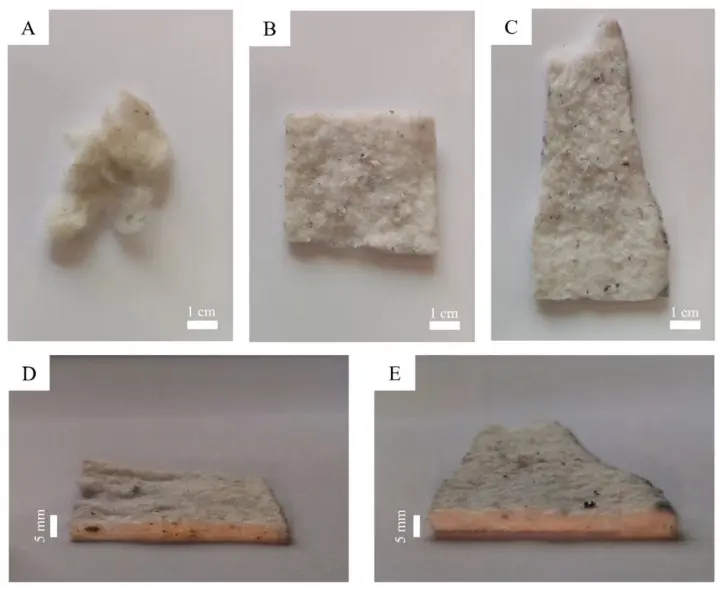
Fig. 13 — Textile products used for phantom production: (A) cotton fiber yarn waste; (B) polyester nonwoven produced by monolayer method; (C) polyester nonwoven produced by sandwich method; (D) cross-section of polyester nonwoven produced by monolayer method; (E) cross-section of polyester nonwoven produced by sandwich method.
In parallel, the project develops optical tissue-mimicking phantoms designed to reproduce light propagation in soft tissues, supporting optical stimulation and imaging studies.
Agarose-based phantoms with tunable absorption and scattering coefficients were formulated to replicate optical properties of different tissue types.
Key features:
• Controlled light penetration depth;
• Reproducible spatial light distribution;
• Compatibility with spectroscopy and imaging techniques.
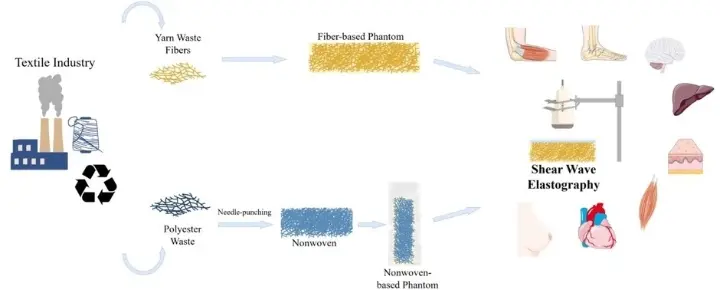
Fig. 14 — Sustainable Shear Wave Elastography Medical Phantoms: Waste-Based Fibrous Structures for Medical Applications
Optical phantoms enable controlled studies of light–tissue interaction, supporting direct comparison between experimental results and numerical simulations.
Fig. 16 — Schematic representation of the fabrication process for: (A) fiber-based phantoms and (B) nonwoven-based phantoms.
Acoustic, mechanical, and optical phantoms are integrated into a multimodal materials framework, enabling combined stimulation studies under controlled and reproducible conditions.
This approach supports:
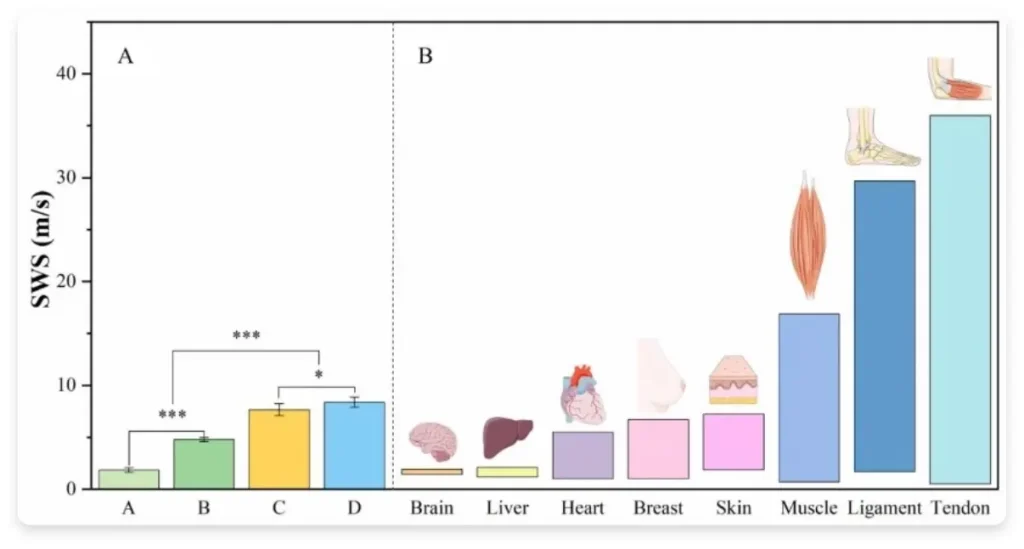
Material behaviour is systematically compared against:
• Numerical predictions;
• Literature reference values for biological tissues;
• Experimental measurements across multiple modalities.
This validation ensures traceability and consistency across the BrainStimMap pipeline.
Fig. 17 — SWS of the (A) developed phantom materials and (B) literature values of various anatomical structures. * p < 0.05; * p < 0.001.
The Materials pillar is supported by peer-reviewed publications, doctoral theses, and supervised research projects, ensuring scientific rigor and long-term reproducibility.
By combining biomimetic material design, controlled fabrication processes, and systematic experimental characterization, the Materials pillar delivers reliable and reproducible testing environments for stimulation technologies.
Challenge us to develop tissue-mimicking materials tailored to your application.