In Vitro Biological Studies

The In Vitro Biological Studies pillar provides the biological validation layer of BrainStimMap, assessing how acoustic and optical stimulation strategies interact with cells and tissue-like environments under controlled conditions.

Why it matters for industry

The main objective is to generate early biological evidence of stimulation effects under controlled conditions, supporting safer and faster technology translation.

Identifies effective and safe stimulation windows

Reduces biological and regulatory uncertainty

Accelerates progression toward preclinical and clinical stages

Experimental Models & Platforms

Biological experiments are conducted using in vitro cellular and tissue-inspired models, designed to isolate and study specific stimulation mechanisms while maintaining experimental reproducibility.

Key features include:

Controlled acoustic and optical exposure conditions;

Controlled acoustic and optical exposure conditions;

Scalable experimental setups for parameter screening.

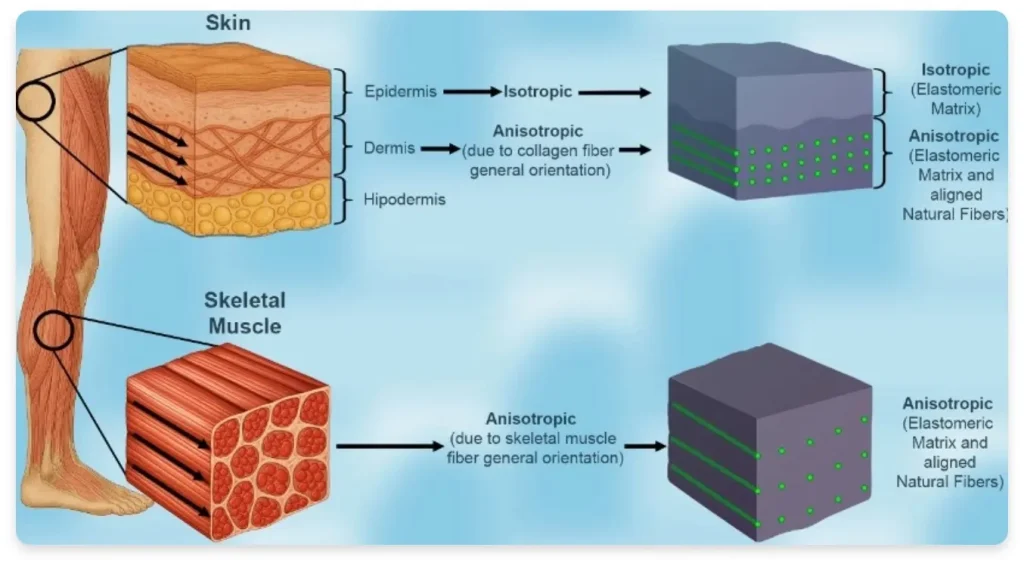
Fig. 18 — Sustainable Tunable Anisotropic Ultrasound Medical Phantoms for Skin, Skeletal Muscle, and Other Fibrous Biological Tissues Using Natural Fibers and a Bio-Elastomeric Matrix

Cellular Response & Mechanisms

The studies focus on evaluating:
Cell viability and integrity | Morphological and functional responses to stimulation | Dose–response
relationships across different stimulation regimes.

These experiments allow identification of safe operating windows and biologically effective stimulation thresholds.

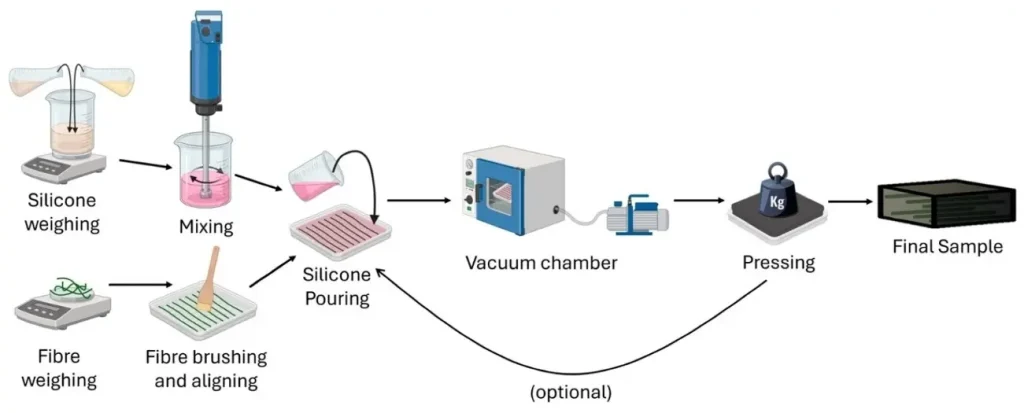
Fig. 19 — A schematic of the fabrication process for the long-fiber silicone composite phantoms, illustrating weighing, mixing, fiber alignment, degassing, and compression steps

Model Validation

Experimental results are used to:

• Validate numerical predictions of pressure, intensity, and exposure;
• Cross-check phantom-based measurements;
• Refine stimulation protocols before technological implementation.

This feedback loop strengthens the from idea to application pipeline.

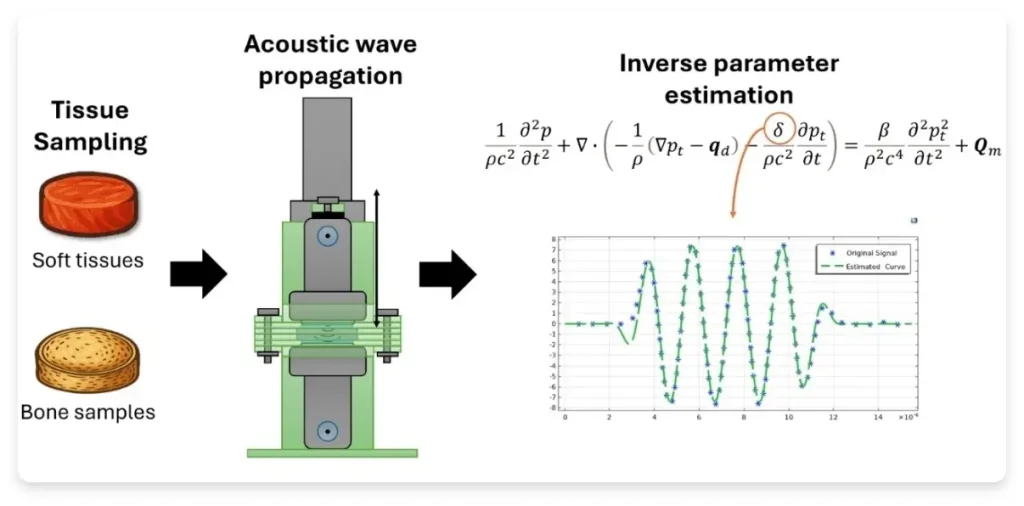
Fig. 19.1 — Experimental Validation of Time-Explicit Ultrasound Propagation Models with Sound Diffusivity or Viscous Attenuation in Biological Tissues Using COMSOL Multiphysics

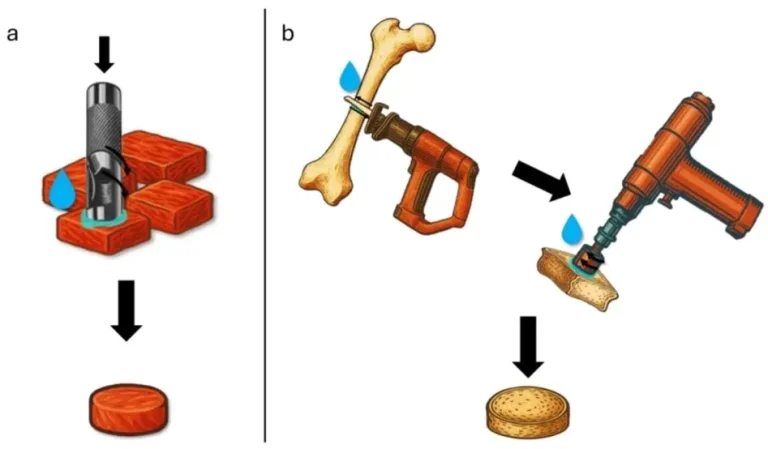
Fig. 20 — Illustration of the sample preparation process—(a) Soft biological tissues were cut into 24 mm discs using a handheld hollow punch, rotated through the sample in a single motion to minimize shear distortion and edge deformation. (b) Bone samples were first trimmed into manageable blocks using a low-speed linear reciprocating saw under continuous saline irrigation to reduce thermal and mechanical damage, then the resulting bone blocks were shaped into cylindrical specimens using a 24 mm hole saw drill bit (without a guide tip), operated at low speed and under coolant, to achieve final dimensions suitable for acoustic testing while preserving structural integrity.

Publications & Scientific Validation

Biological findings are supported by peer-reviewed publications and supervised doctoral research, ensuring scientific robustness and regulatory relevance.

From Simulation to Application

By combining biomimetic material design, controlled fabrication processes, and systematic experimental characterization, the Materials pillar delivers reliable and reproducible testing environments for stimulation technologies.

Challenge us to develop tissue-mimicking materials tailored to your application.